Quick Answer: can a brand grow on social without a face?
Yes, and for most product businesses it is the more durable choice. Founder-led content compounds faster in year one and then becomes the single point of failure: the founder is the bottleneck on every post, the audience belongs to the person rather than the company, and the day they stop — or leave — the channel stops with them.
A faceless brand account trades early velocity for something a founder-led account structurally cannot have: it survives a staff change. If you sell a physical product, you also have the one thing that makes faceless easy, which is a subject that is not a person. The product is the protagonist.
This is a different problem from a faceless creator channel. A creator is monetising attention and needs volume. A brand is selling something specific to a defined audience and needs the right hundred people, not the wrong hundred thousand.
At a glance
| Who this suits | Product brands, e-commerce stores, B2B SaaS, agencies running client accounts, any team where nobody wants to be on camera |
| The core trade | Slower initial growth, no key-person risk, transferable between staff |
| What replaces the face | The product, a fixed visual system, a consistent voice, and a point of view |
| Hardest part | Consistency across months without a personality to carry it |
| What to automate | Production and publishing — never engagement |
The case against founder-led, stated fairly
Founder-led content genuinely works, and it works faster. People follow people, a face is the cheapest source of trust available, and a founder with a point of view can build an audience in months that a brand account takes years to build. If your founder wants to do it and is good at it, do it.
The honest problems are three, and none of them show up in year one.
Key-person risk. The audience followed a person. If that person leaves, goes quiet, or becomes a liability, the channel does not transfer. Companies have discovered this expensively.
It does not scale past one calendar. Every post needs the founder — to film, to approve, or to be the subject. That is a hard ceiling on volume, and it is the same ceiling whether you have one product or four hundred.
Most founders do not want to. This is the quiet one. A large share of the "we should do more video" conversations stall here, and the honest answer is not to push a reluctant person onto camera, because reluctance is visible and it performs badly.
A faceless account has none of those problems and a different one: nothing carries it but the work. That is a fair trade if you are willing to do the work.
What replaces the face
A face does four jobs on a social account. A faceless brand has to do each of them another way, and skipping any one is what produces the generic corporate feed nobody follows.
- Recognition in the scroll. Replaced by a fixed visual system — same palette, same type, same frame-one structure, applied without exception. This is non-negotiable and it is the one most brands break within a month.
- Trust. Replaced by specificity. Real numbers, real process, real constraints, named sources. A faceless account earns trust by knowing things, and generic advice reads as untrustworthy precisely because anyone could have written it.
- Consistency of voice. Replaced by a written voice document that every generation step reads. If you automate copy without pinning voice, you get the house style of whichever model you happened to use.
- A point of view. Not replaceable — you just have to have one. A brand account with no opinion is a catalog, and catalogs do not get followed.
The format mix for a product brand
These are the faceless formats that work when you have a product rather than a personality.
Process and craft. Hands only — the product being made, packed, repaired, assembled. Consistently the strongest performer for physical-product brands and completely faceless by nature. Film it once in bulk; it re-cuts for months.
The product in use. Not a studio shot on a white background. The thing working, in the situation it was bought for, with the problem visible before the product appears.
Data and receipts. Numbers only you have — from your own orders, support tickets, returns, production runs. This is the most defensible faceless content in existence because nobody else can generate it from a prompt, and it is the format most likely to be quoted back at you.
Customer content. Reviews, unboxings, results. Somebody else's face, which is better than yours, because it is evidence rather than assertion.
Teaching the category. Answer the questions your support inbox answers. This is also the content most likely to get cited when someone asks an AI assistant about your category — see our GEO guide for why that is now a distribution channel in its own right.
Running it from the catalog, not from a calendar
Here is the structural advantage a product brand has over a creator, and almost nobody uses it: your content calendar already exists — it is your catalog.
Every new product, restock, price change and seasonal line is a content event that already happened in a system of record. A creator has to invent a topic each day. You have to notice one.
That makes the trigger different. A creator's faceless workflow fires on a schedule. A brand's best faceless workflow fires on a store event: a new product appears in Shopify or WooCommerce and a set of platform-specific posts is generated and published without anyone opening a tool. Both stores connect read-only — nothing writes back to your store — and the product's own details are what the copy is built from, rather than something you paste into a chat box.
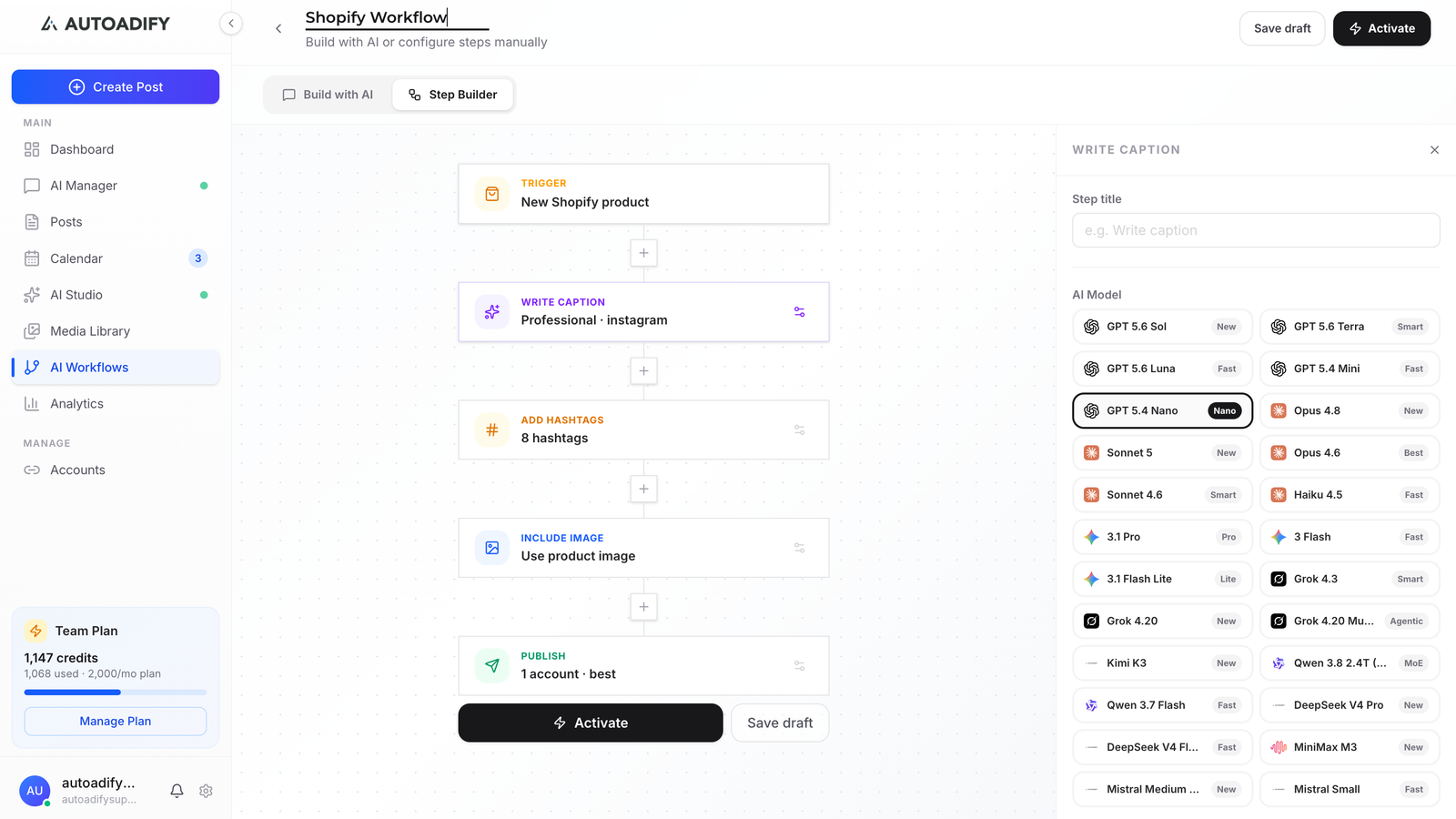
In practice most brands run both: a catalog-triggered workflow for product events, and a scheduled one for the teaching and process content that keeps the feed alive between launches. The Shopify catalog guide and the WooCommerce equivalent cover the connection details for each.
What a brand should not automate
The automation line is stricter for a brand than for a creator, because a brand account has more to lose from one bad post than it has to gain from ten good ones.
| Activity | Automate? | Why |
|---|---|---|
| Product-launch posts from the catalog | Yes | The facts come from your store. Low variance, high volume, exactly the automatable shape. |
| Per-platform copy for ten networks | Yes | Ten captions is where the hours go, and it is mechanical work. |
| Evergreen teaching content | Yes, with review | Automate the drafting, read it before it ships, at least for the first month. |
| Anything with a price or a claim in it | Careful | A wrong price is a chargeback. Pull prices from the catalog, never from a model. |
| Crisis, apology, anything sensitive | No | A human writes this, every time, with no exceptions worth carving out. |
| Comment replies, DMs, customer service | No | Engagement. Autoadify ships none of it, deliberately. |
Which brings up the distinction that decides how safe this is to run on a brand account. There are two levels of automation, and they are not the same thing:
- The AI Agent works on request, in the workspace. Ask for a campaign and it researches, writes, generates images and video and proposes a schedule — then stops. Its three action tools require explicit approval, enforced in the execution path rather than asked for in a prompt, and no setting removes that. For a brand account, this is the default.
- AI Workflows are the unattended path — a trigger fires and the post publishes with nobody in the loop. Correct for high-volume, low-variance content like catalog posts. Wrong for anything where a bad post is expensive.
Most brands should run the agent for campaign work and reserve workflows for the catalog pipeline. That is the split that gets you volume without handing an unattended process the ability to embarrass you. The guardrails post covers how to draw that line properly.
Frequently Asked Questions
Can a business grow on social media without showing faces?
Yes. Product brands have an easier time of it than creators do, because the product supplies the subject a face would otherwise provide. The trade is slower early growth in exchange for a channel that transfers between staff and does not depend on one person continuing to show up.
Is faceless content worse than founder-led content?
It grows more slowly at the start and it is more durable afterwards. Founder-led content builds trust faster because people follow people; faceless content survives the founder leaving. If the founder genuinely wants to be on camera, do both — the brand account is the one that still exists in five years.
What content works for a faceless brand account?
Process and craft shot hands-only, the product in the situation it was bought for, data from your own orders and support tickets, customer content, and teaching the category. Data from your own operations is the most defensible of these, because no competitor can generate it from a prompt.
How do you automate social media for an e-commerce store?
Trigger on the catalog rather than on a calendar. A new product in Shopify or WooCommerce fires a workflow that generates platform-specific copy and visuals from the product's own details and publishes across your connected accounts. Both stores connect read-only, so nothing writes back to the store.
Should a brand let AI publish without approval?
For catalog posts, reasonably — the facts come from your store and the variance is low. For campaign work, no. Run the agent, which always stops for approval on every publishing action, and keep unattended workflows to the content where a mistake is cheap.
What does it cost to run a faceless brand account?
Autoadify is Free ($0), Pro ($29/mo), Team ($79/mo) and Enterprise ($299/mo), billed per workspace rather than per seat or per channel. Workflows start on Pro — they are not on the Free tier — and Team is the realistic tier for a brand running multiple stores and a video-heavy cadence.
The Bottom Line
Going faceless is not a compromise for brands that cannot find a presenter. It removes key-person risk, lifts the volume ceiling, and lets the product be the protagonist — which, for a product business, it should have been anyway. Replace the four jobs a face was doing, trigger the pipeline off the catalog rather than a calendar, automate production and publishing, and keep every reply and anything sensitive in human hands.
See it work
Autoadify syncs Shopify and WooCommerce catalogs read-only, generates per-platform copy, images and video, and publishes natively to ten networks — with the approval gate on every agent action and unattended publishing reserved for workflows you configured. Start free, or read the full faceless workflow build.
Ready to automate your social media?
Autoadify gives you access to 70+ AI models, auto-scheduling across 10+ platforms, Shopify sync, and AI agents — all in one platform.
Start free